The Pink Tax: Why Upcharging Women is an Industry Habit

Why do items like basic white T-shirts, body washes, and disposable razors cost more the minute they are marketed towards women? Majority of the time, it's not because they are better in quality. Take body washes, for example: ones that are advertised towards men and ones towards women have nearly the same ingredients and function, but cost 6% more and often contain less product.
Welcome to the Pink Tax, a gender-based, systematic price markup on goods and services advertised to women of all ages. For decades, the industry used the "shrink it, pink it” method, charging female customers a premium–which makes products on average 13% more expensive–that isn't present for the same product sold to men.
To fully understand how this price discrimination works, we have to talk about two commonly confused concepts: the Pink Tax and the Tampon Tax.
While both place an unfair burden on women, they stem from completely different sources. The Pink Tax is an unofficial, corporate markup that happens when manufacturers and retailers charge a higher base price for products and services designed, packed, and advertised towards women–ranging from dry cleaning services to toys to haircuts. There is no law that requires this fee, it's just a profit-driven discrimination hidden behind gender-targeted marketing.

The Tampon Tax is (again, an unofficial) state-level policy. It refers to the unfair taxation of menstrual products such as pads, tampons, and menstrual cups. Whereas in other states, over the counter items like painkillers are labeled as “ tax-exempt medical necessities” while menstrual products are taxed as “luxury goods". Unlike the Pink Tax, which goes straight into the pockets of private corporate companies, the Tampon Tax goes to the state government. According to Period.org, “...an estimated $130 million is still collected each year in sales tax on period products across the country”. Although many states have exempted period products from the Tampon Tax, there are still 18 states that do. At the end of the day, women are paying a physical price–and 18 states are charging them a financial one too.

Even though one is driven by corporate greed and the other by outdated tax legislation, they are both fundamentally linked. Together, they create a compound economic penalty: private corporations mark up the base cost of basic hygiene products, and state governments make more money by taxing the products that women cannot opt out of buying.
What may seem like a few extra dollars spent on products adds up FAST over 12 months. The average cost of the Pink Tax for a woman is approximately $1,351 a year. An extra thousand dollars might sound like a small change when you break it down day by day, but in context, it's substantial. That amount you pay is equivalent to 2 car insurance payments, electric bills, or buying a new laptop every year. $1,351 breaks down to $3.07 a day, which is the price of a cup of standard brewed coffee.
The money spent on price markups isn’t just lost cash–it’s a lost investment opportunity. When the same $1,351 is invested into a stock market index fund with an annual return rate of 7%, you would make more than what you spent:

After investing for 60 years, you would have spent around $80,000 but be left with over $1 million after investing! This compounding loss doesn’t happen in a vacuum–it directly feeds into the gender wealth gap. Women already face a wage gap, earning less on average for equal work, which leaves them with a tight budget and less spending money from the start. To then force women to spend more on basic hygiene items and period care products creates a double standard. In a study conducted by Thinx and Period, “... of 1,000 females, 1 in 5 teens have struggled to afford period products or were not able to purchase them at all.” Let that sink in! Both taxes on products make it harder for females to have access to basic hygiene products, housing, nutrition, and healthcare. By draining thousands of dollars that could otherwise build an emergency fund, pay debt, save for retirement, or grow in an index fund, the Pink Tax and Tampon Tax do far more than inflate retail prices. It actively erodes women’s long-term financial independence and takes away the opportunity for future generations of women to accumulate wealth and make a start for themselves.

From the moment she is born, a girl is exposed to the Pink Tax, starting all the way from toys and clothes. When in a girls section of toys or clothing, you might find a headache-inducing amount of items in pink. Girls clothing on average cost 4% more than boys, with items including baby clothes, shirts, shoes, etc. These markups on daily items and menstrual products are not by accident, they are systematic markups enforced by private corporations and the government that are meant to make a profit. From razors and clothing to pads and tampons, gender-based pricing drains women of thousands of dollars every year. Which over a lifetime, compounds into a million dollar barrier, creating the financial gender gap and making it harder for lower-income women to afford a quality lifestyle, and affects their self-image. Until equality is present at the checkout line, women will continue to pay an outrageous premium for existing, all while we could be earning over a million dollars in lifetime wealth. It’s time to #AxThePinkTax!
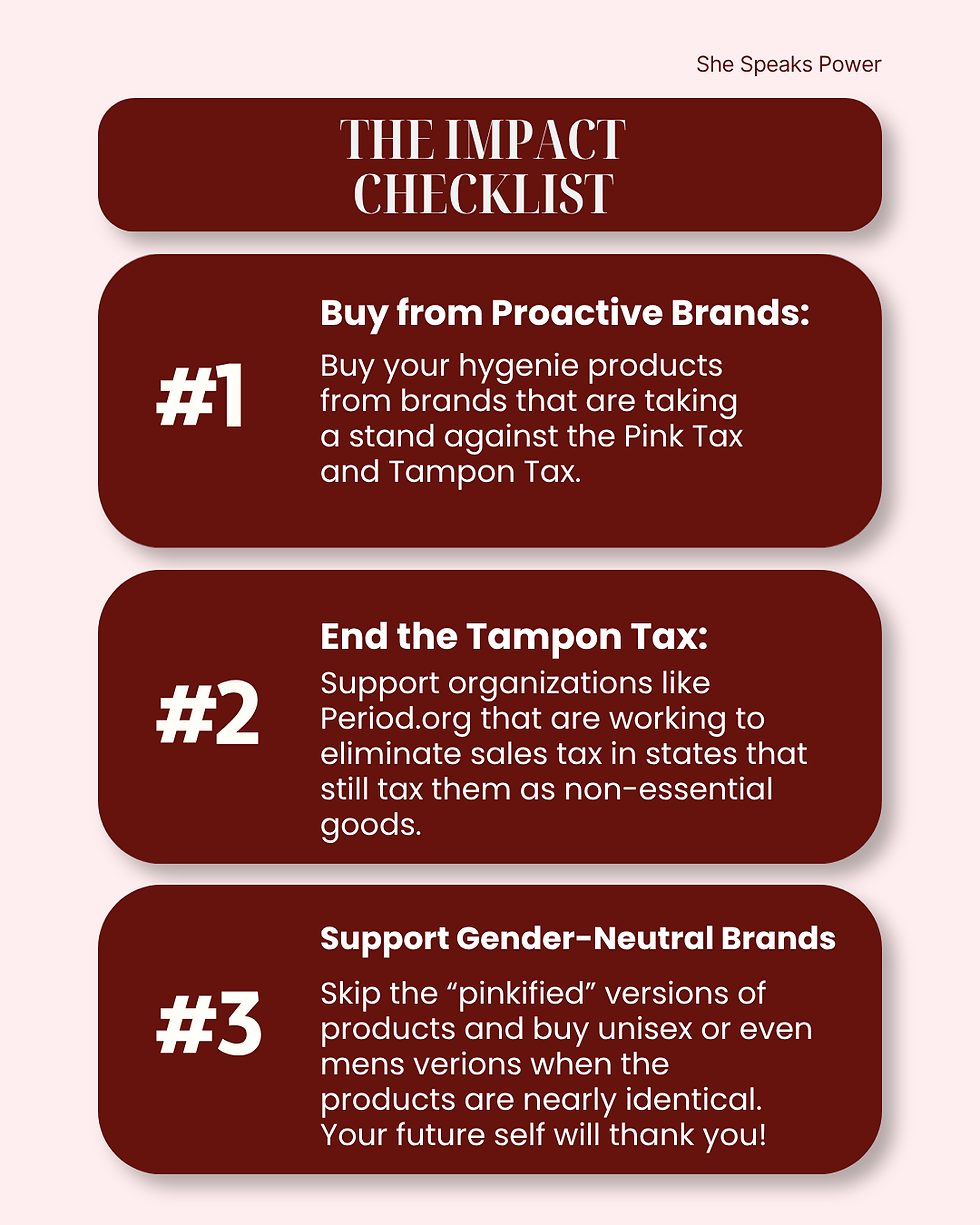
Further Reading & THE IMPACT CHECKLIST:
Make sure to follow She Speaks Power on Instagram to stay informed as soon as there's a new post!
Further Reading Links:
Period.org - Period Policy Updates
Here are three easy ways you can make an impact within your community!


Wow Vrinda ! You are such a good writer from a very young age. We were able to know more about the pink tax and tampon tax through this article. It was very informative 👍 keep up the good work! So proud of you my girl 💜🤗
So proud of you to think about all the topics. I am sure this is the beginning. Always stand up for your rights. I will support you. Best of luck
Your post explained this topic so well! Thank you for spreading awareness on how anyone can make a difference in fighting this issue!